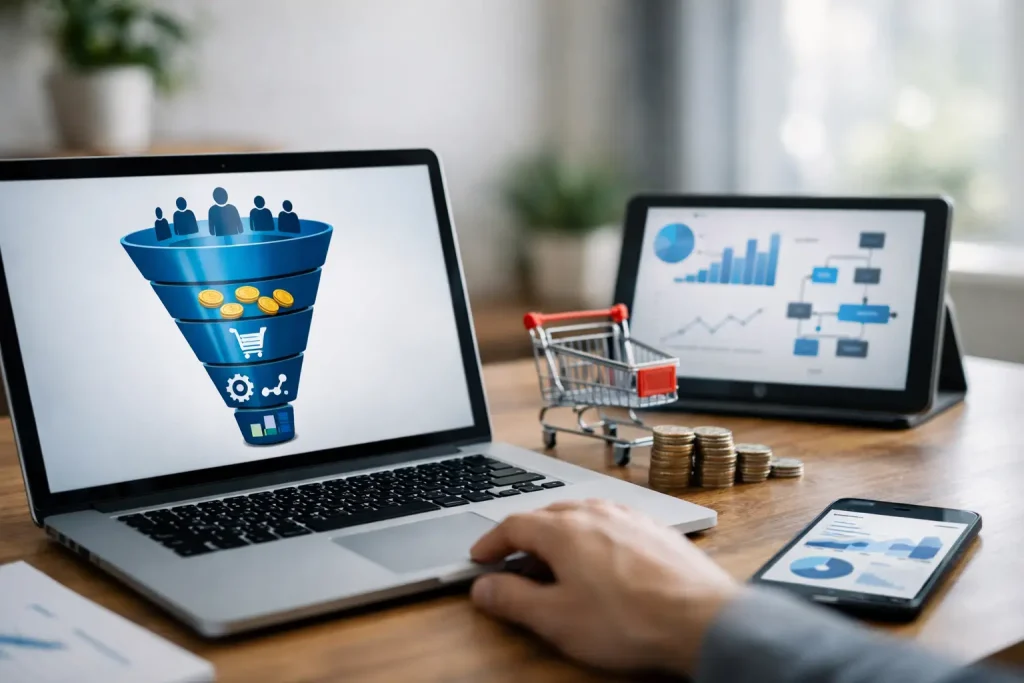

Most beginners do not fail because they picked the wrong affiliate offer. They fail because every sale depends on another manual post, another DM, or another hour spent explaining the same thing. Automated sales funnels beginners can build changes that equation. Instead of chasing every prospect, you create a simple path that captures attention, builds trust, and makes the next step clear.
That does not mean pressing a button and watching money appear. A funnel is not magic, and automation cannot rescue a weak offer or a message nobody wants. What it can do is stop you from rebuilding your marketing from scratch every day. You create the core assets once, improve them over time, and let the system follow up while you focus on traffic, content, and better opportunities.
What an automated sales funnel actually does
An automated sales funnel is a sequence of pages, emails, and follow-up actions that moves a stranger toward a purchase without requiring you to personally handle every conversation. Someone sees a Facebook post, short video, ad, or referral. They click to a landing page, exchange their email for something useful, and enter an email sequence that helps them understand the problem, evaluate the solution, and take action.
For affiliate marketers, the final action may be registering for a webinar, reviewing a high-ticket offer, booking a call, or purchasing through your referral link. The details vary, but the business advantage stays the same: you are building an asset that can work after you log off.
Think of the funnel as a guided conversation. Your traffic source starts the conversation. Your landing page earns permission to continue it. Your emails provide context and proof. Your offer gives the prospect a decision to make. Each piece has one job, which is why a focused funnel usually converts better than sending cold visitors straight to a sales page.
The beginner funnel that makes the most sense
You do not need ten pages, complicated tagging, or a library of fifty emails to begin. In fact, too much complexity is one of the fastest ways to stall. Start with a lean funnel that gives you data and creates a real customer journey.
1. A clear traffic message
Your message should connect a specific frustration to a believable outcome. “Make money online” is too broad to earn much attention. “Stop relying on low-ticket commissions and build an email list that can promote higher-value offers” is more useful because it speaks to a known problem.
The goal is not to attract everyone. It is to attract people likely to care about your next step. If you target aspiring affiliate marketers, speak directly to their problems: inconsistent traffic, low commissions, confusion around tools, and the feeling that they need to be online all day to make progress.
2. A landing page with one promise
A landing page should make a single exchange feel worthwhile. The visitor gives you an email address. You give them a practical resource, training, checklist, webinar registration, or short guide that solves a small but urgent problem.
Avoid trying to explain your entire business on this page. Lead with a benefit, make the offer easy to understand, and use one call to action. If a person cannot tell what they get within a few seconds, the page is asking them to work too hard.
3. A useful lead magnet or webinar
Your lead magnet is the bridge between curiosity and trust. It should deliver a quick win, not a vague collection of motivational ideas. A beginner-friendly example could be a five-step plan for choosing a high-ticket affiliate offer, a simple Facebook lead-generation checklist, or a short training on turning social traffic into email subscribers.
A webinar can be even more effective when your offer needs explanation. It gives you room to teach, demonstrate the opportunity, handle common objections, and introduce a relevant next step. A recorded webinar is especially valuable because it is reusable. Once the presentation is solid, new leads can watch it at times that suit them, not only when you are available live.
4. An email sequence that earns the click
Email is where the follow-up happens. Most people will not buy after one visit, particularly when they are considering a higher-priced offer. A short sequence lets you show up consistently without manually writing to every lead.
Your first email should deliver what you promised. The next few messages can explain the problem, share a useful strategy, tell a relevant story, and introduce the offer as a logical solution. Be direct, but do not turn every email into a hard pitch. If every message says “buy now,” readers learn to ignore you. If your emails teach them something and help them make a smarter decision, sales become a more natural outcome.
How to build your first funnel without getting buried in tools
Start by choosing one offer and one audience. This is where many beginners overcomplicate things by promoting several unrelated products at once. One clear offer makes it easier to write the landing page, create the lead magnet, and build emails that all point in the same direction.
Next, map the funnel on a single sheet of paper before you open any software. Write the traffic source, the landing-page promise, the thank-you-page action, the five to seven emails you will send, and the main offer. If you cannot explain the path simply, your prospect will not understand it either.
Then build the minimum version. Use a landing page, a form connected to your email platform, a thank-you page, and an automated email sequence. Test every link and form yourself. Subscribe using a second email address, confirm that the delivery email arrives, and make sure the call to action works on mobile. Small technical breaks can cost you leads without you realizing it.
Do not wait for perfect branding, custom graphics, or a massive content library. A plain page with a strong promise and useful follow-up will outperform a polished funnel with a confusing message. Once it is live, drive a small amount of targeted traffic and watch what happens. Are people opting in? Are they opening emails? Are they clicking through to your webinar or offer? Those numbers tell you what needs attention.
Traffic comes before scale
Automation gives you leverage, but it does not generate attention by itself. You still need a consistent traffic plan. For many beginners, organic social content is the best place to learn because it costs more time than money. Create posts and short videos around the same problem your funnel solves, then invite interested people to get the related resource or training.
Facebook can be particularly useful when you understand who you want to reach and what language they use. Share practical lessons, personal observations, and simple before-and-after outcomes. Avoid dropping affiliate links everywhere. Sending people first to your lead capture page gives you a chance to build an audience you can contact again.
Paid traffic can speed up testing, but it is not automatically the right first move. If your landing page and emails are unproven, ads can turn into expensive guesswork. Validate the message with organic traffic or a small budget first. When you know people opt in and engage, scaling becomes a decision based on data instead of hope.
Mistakes that quietly kill beginner funnels
The biggest mistake is trying to automate a process before you understand the customer. If you do not know why someone hesitates, what they want, or what result they expect, more software will only automate confusion. Talk to your audience through comments, replies, and simple surveys. Their words can improve your copy faster than clever marketing jargon.
Another common mistake is sending leads directly to a high-ticket sales page with no context. Some offers can convert this way, especially when the traffic is warm. But cold prospects often need education and proof first. A lead magnet, short training, or webinar creates the trust needed for a bigger decision.
Finally, do not judge a funnel after two days. Funnels improve through testing. Change one meaningful variable at a time, such as the headline, the lead magnet promise, or the email subject line. If you change everything at once, you will not know what created the result.
Your first automated funnel does not need to be impressive. It needs to be clear, useful, and live. Build the simplest path that helps the right person take one next step, then let real responses show you where to improve. That is how a side-hustle marketing effort starts becoming an online business with assets that keep working.